
Pour Decisions: A Guide to the Gooseneck Pour Over Kettle
Why the Gooseneck Pour Over Kettle is Essential for Brewing
If you’ve ever tried to brew a pour-over with a standard tea kettle, you know the frustration of the “glug.” One second you’re aiming for the center, and the next, a tidal wave of water has collapsed your coffee bed and splashed up the sides of the filter. This is why the gooseneck pour over kettle is a non-negotiable for us at Rede Ponto.
The secret lies in the physics of the pour. Because the spout is narrow and exits from the base of the kettle, the water pressure remains constant regardless of how much water is left inside. This allows for a 90-degree vertical flow, which is essential for uniform saturation.
When we talk about “blooming” coffee, we are referring to the initial saturation of the grounds. Freshly roasted, ethically sourced beans are full of CO2. When hot water hits them, they off-gas, creating a bubbly “bloom.” If you dump water too quickly, you trap that gas, which prevents water from actually penetrating the coffee particles. A gooseneck allows you to gently wet every single grain, ensuring that the CO2 escapes and the water can do its job: extracting those delicious oils and flavors.

Furthermore, the controlled flow reduces “channeling.” Channeling happens when water finds a path of least resistance through the coffee bed rather than flowing through it evenly. By using a precise, circular motion, you maintain a flat coffee bed and ensure every drop of water works for its living. According to Scientific research on the physics of water flow in coffee extraction, the way water moves through the porous media of coffee grounds directly dictates the chemical composition of your final cup.
Electric vs. Stovetop: Choosing Your Heating Method
Once you’ve decided to upgrade your setup, the next big question is whether to go electric or stay traditional with a stovetop model. In our experience, this choice usually comes down to how much you value convenience versus counter space.
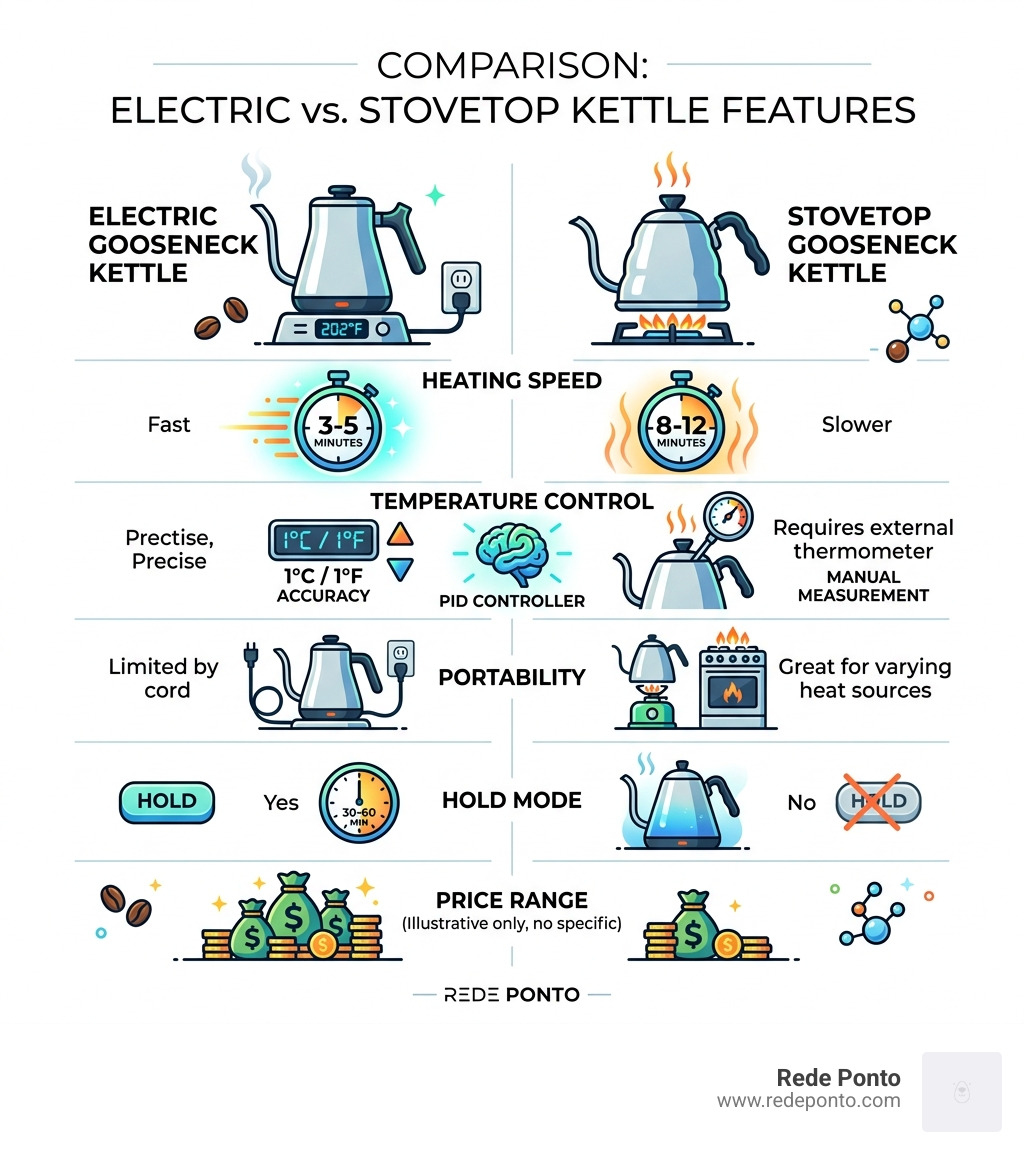
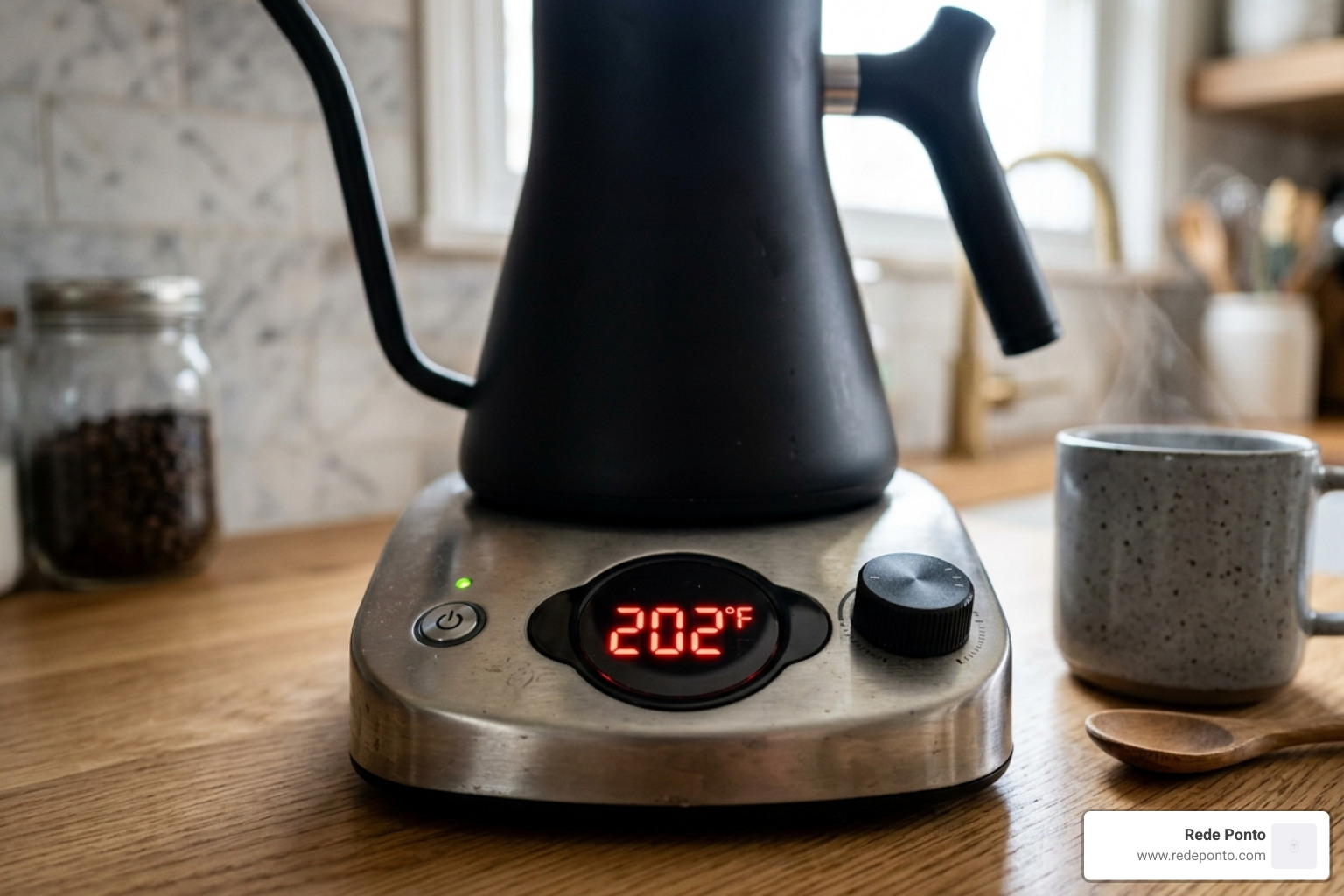
Electric Gooseneck Kettles These are the heavy hitters of the coffee world. Most modern electric models feature 1200W to 1500W heating elements, meaning they can bring a full liter of water to a boil in under five minutes. The real “magic” of high-end electric kettles is the PID (Proportional-Integral-Derivative) controller. This is a fancy way of saying the kettle has a brain that prevents it from overshooting your target temperature. If you set it to 202°F, it stays at 202°F.
Stovetop Gooseneck Kettles These are elegant, durable, and often more affordable. They are great for those who already have a reliable heat source, like a gas or induction range. However, keep in mind that stovetop models typically take longer to heat—sometimes up to 12 minutes if the walls are thick and the heat is low. You also have to be more careful with gas flames; if the flame “licks” the side of the kettle, it can discolor the finish.
| Feature | Electric Kettle | Stovetop Kettle |
|---|---|---|
| Heating Speed | Fast (3–5 minutes) | Slower (8–12 minutes) |
| Temp Control | Precise (Degree by degree) | Requires external thermometer |
| Portability | Limited by cord/outlet | Great for camping/gas stoves |
| Price | $50 – $200+ | $25 – $100 |
| Hold Mode | Yes (often 30–60 mins) | No |
For those living at high altitudes, electric kettles are a godsend. Since water boils at lower temperatures the higher you go, many electric models allow you to calibrate the settings so the kettle doesn’t try to reach a boiling point that is physically impossible in your kitchen. You can find more info about specialty coffee equipment on our site to help narrow down your choice.
Key Features to Look for in a Gooseneck Pour Over Kettle
Not all kettles are created equal. When you’re shopping for a gooseneck pour over kettle, you want to look past the shiny exterior and check the specs.
- Material: Look for 304 stainless steel. This is food-grade, rust-resistant, and won’t leach a metallic taste into your water.
- Handle Ergonomics: You’ll be holding this kettle for several minutes at a time. A counterbalanced handle shifts the center of gravity toward your hand, making the pour feel effortless rather than a workout for your wrist.
- Finger Spacing: Look for at least 12mm of spacing between the handle and the kettle body. This prevents your knuckles from brushing against the hot steel—a mistake you only make once!
- Flow Rate: Some kettles have a “restricted” flow (around 2ml/s), while others are faster. Beginners often prefer a slower, more restricted flow because it’s harder to mess up.
Ideal Capacity for Your Gooseneck Pour Over Kettle
Capacity is a “Goldilocks” situation. If the kettle is too small (like the 350ml travel versions), you won’t have enough water to rinse your filter and brew a full mug. If it’s too large (over 1.2L), it becomes heavy and difficult to control.
The “sweet spot” for most home baristas is 0.8L to 1.0L (about 27 to 34 ounces). This provides enough water for two large cups of coffee plus the initial rinse, without making the kettle feel like a dumbbell.
Precision Temperature Control for the Perfect Brew
Temperature is the “speed limit” of extraction.
- Light Roasts: 200°F – 212°F. Hotter water is needed to extract flavors from these denser beans.
- Medium Roasts: 190°F – 200°F.
- Dark Roasts: 185°F – 190°F. Cooler water prevents the bitter, ashy flavors from taking over.
Most premium electric kettles offer a “Hold Mode” that maintains your set temperature for 30 to 60 minutes. This is vital because if your water temperature drops 10 degrees halfway through your pour, your extraction will be inconsistent. For more on the science, check out Scientific research on optimal brewing temperatures.
Mastering the Pour: Techniques for Better Coffee
Owning the kettle is step one; using it correctly is step two. Here is our recommended routine for a perfect pour:
- The Rinse: Pour hot water through your paper filter into the server. This removes the “papery” taste and warms up your equipment.
- The Bloom: Pour about double the weight of the coffee in water (e.g., 40g of water for 20g of coffee). Start in the center and spiral outward. Wait 30-45 seconds.
- The Main Pour: Use a slow, steady circular motion. Aim for a 90-degree vertical flow. Avoid pouring directly against the walls of the filter, as water will bypass the coffee grounds entirely (this is called “bypass”).
- The Pulse: Instead of dumping all the water at once, pour in “pulses.” This keeps the water level consistent and maintains a steady temperature in the brew bed.
Maintenance and Safety: Keeping Your Kettle in Top Shape
A gooseneck pour over kettle is an investment, and like any precision tool, it needs care. The biggest enemy of your kettle is limescale—mineral buildup from hard water.
How to Descale: Don’t use harsh chemicals. A simple solution of one part white vinegar to one part water (or 2 tablespoons of citric acid per liter) does the trick. Fill the kettle, bring it to a boil, and let it sit for 15-30 minutes. Rinse it thoroughly afterward, and your kettle will look brand new.
Safety First: Always look for kettles with boil-dry protection. This feature automatically shuts the kettle off if there isn’t enough water inside, preventing the heating element from burning out or starting a fire. Also, ensure your kettle has an auto shut-off function that kicks in once the target temperature is reached. You can find more info about coffee brewing accessories on our maintenance page.
Frequently Asked Questions about Gooseneck Kettles
Can I boil milk or tea directly inside the kettle?
No! We strongly advise against this. Electric kettles are designed specifically for water. Milk contains fats and sugars that will burn onto the heating element, causing permanent damage and a lingering smell that will ruin every future cup of coffee. For tea, it’s best to boil the water and then pour it over your leaves in a separate teapot.
Do gooseneck kettles whistle like traditional stovetop kettles?
Generally, no. Most gooseneck kettles are designed for specialty coffee, where silence is part of the ritual. Stovetop models usually don’t have a whistle because the narrow spout doesn’t allow for the necessary steam pressure. Electric models will usually give a polite “beep” or simply click off when ready.
How often should I descale my kettle to prevent mineral buildup?
This depends on your water hardness. If you have very hard water, you might need to descale once a month. If you use filtered water, you might only need to do it every 3-4 months. A good rule of thumb is to look at the bottom of the kettle—if you see white, chalky spots, it’s time for a cleaning.
Conclusion
At Rede Ponto, we believe that coffee is more than just a morning caffeine fix; it’s a ritual that deserves respect. Choosing the right gooseneck pour over kettle is a commitment to that ritual. Whether you opt for a high-tech electric model with Bluetooth features or a classic, patented stovetop design, the control you gain will transform your brewing experience from “good enough” to “extraordinary.”
By focusing on precision, temperature stability, and ethical brewing practices, you aren’t just making coffee—you’re crafting a masterpiece. Start your ethical brewing journey with Rede Ponto and discover how the right tools can make every pour a “pour decision” you’ll never regret.
