
Stop Spilling the Beans and Learn the Farm to Cup Process
What “Direct Farm to Cup” Really Means (And Why It Matters for Your Morning Brew)
Direct farm to cup is a coffee sourcing model where one company controls every step of the supply chain — from growing the coffee plant to roasting and delivering it to you. No brokers. No commodity warehouses. No mystery.
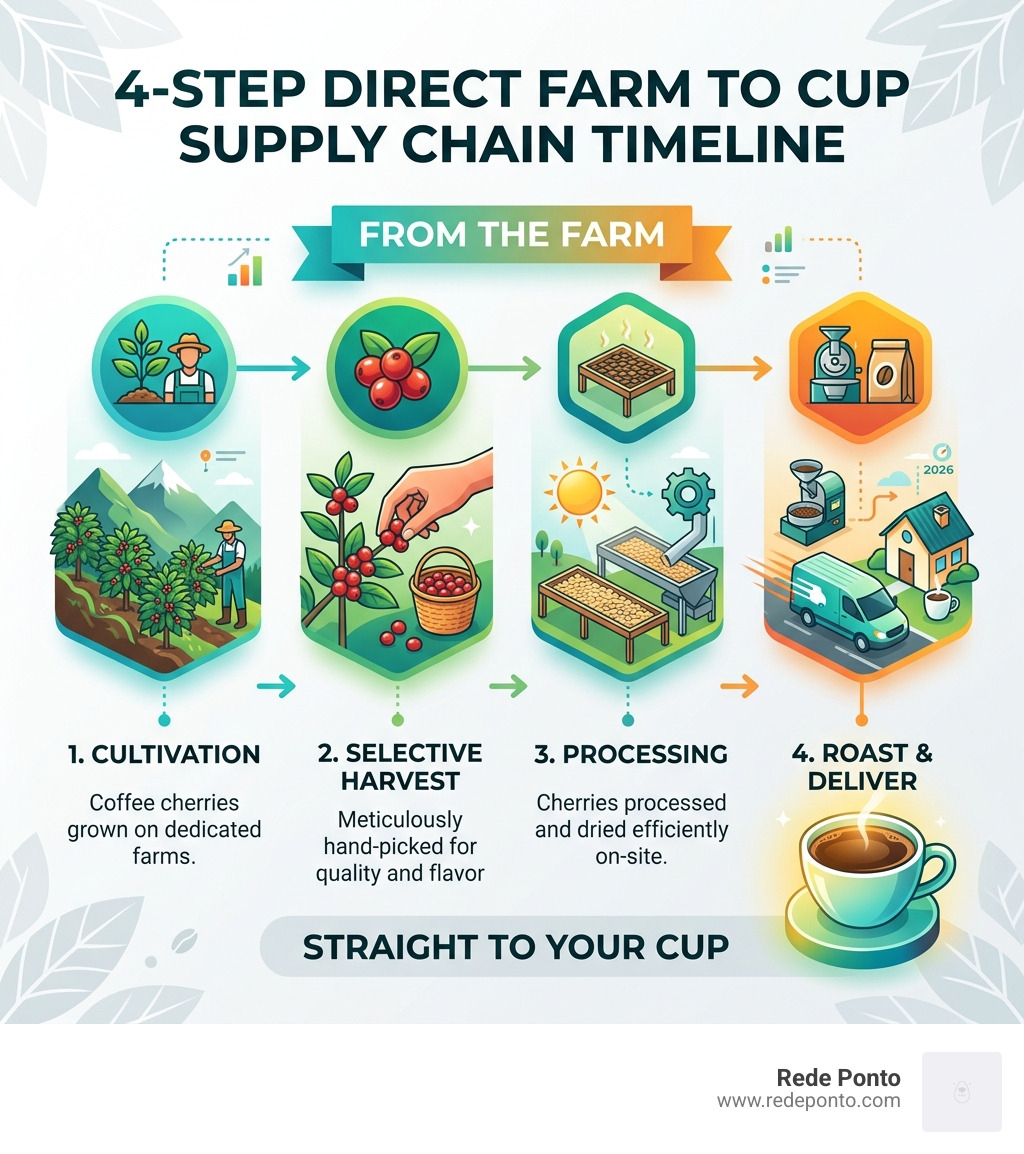
Here’s the quick version of what that journey looks like:
- Grow — Coffee cherries are cultivated on a farm owned or directly operated by the brand
- Harvest — Only ripe cherries are hand-picked for maximum flavor
- Process — Beans are de-pulped, fermented, and dried on-site
- Roast & Deliver — Small-batch roasting happens close to the source, then ships straight to you
This is fundamentally different from how most coffee works. In a traditional supply chain, your beans pass through five or more middlemen — local buyers, exporters, importers, brokers, and roasters — before reaching your cup. That journey can take 6 to 18 months.
With a true direct farm to cup model, that same journey takes days to weeks.
But here’s the thing most coffee bags won’t tell you: almost anyone can print “farm-to-cup” on their packaging. Very few brands have actually earned it. In fact, less than 1% of coffee shops and brands in the world actually own the farm where their coffee is grown.
That gap between marketing and reality is exactly what this guide unpacks.
Defining the Direct Farm to Cup Model

When we talk about direct farm to cup, we are talking about vertical integration in its purest form. In the traditional world of commodity coffee, the person who grows the bean rarely knows the person who drinks it. The supply chain is a “black box” where quality is averaged out and accountability is non-existent.
In a true farm-to-cup model, the brand acts as the farmer, the processor, the exporter, and the roaster. By removing the middlemen who extract value without adding quality, the company gains absolute control. This isn’t just about logistics; it’s about accountability. When one entity oversees the seed being planted and the final bag being sealed, there is nowhere for defects or unethical practices to hide. According to SCA research on sustainability, transparency is the foundation of a resilient coffee industry, and this model is the gold standard for that transparency.
The Rarity of True Direct Farm to Cup Ownership
You might see the term used on every other Instagram post, but the reality is that true direct farm to cup ownership is incredibly rare. As mentioned, less than 1% of coffee entities worldwide actually own their farms. Why? Because coffee farming is difficult, risky, and expensive.
Owning a farm requires massive capital investment in land and infrastructure. It also requires deep agricultural expertise—knowing how to fight coffee rust, manage soil acidity, and predict harvest cycles. Most coffee shops are great at making lattes, but they aren’t equipped to manage a 30-acre plantation 3,000 feet above sea level. For most, the operational risk of a bad harvest or a hurricane is simply too high, which is why they stick to buying from importers.
How It Differs from Fair Trade and Direct Trade
It is easy to get lost in the “alphabet soup” of coffee labels. Let’s break down how direct farm to cup stands apart from other popular models.
| Feature | Commodity Coffee | Fair Trade | Direct Trade | Farm-to-Cup |
|---|---|---|---|---|
| Price Paid to Farmer | Market Minimum | Small Premium | High (Negotiated) | Highest (Direct Profit/Wage) |
| Middlemen | 5-7 | 4-6 | 2-3 | 0 |
| Traceability | None (Blended) | Cooperative Level | Farm Level | Tree/Lot Level |
| Relationship | Anonymous | Institutional | Partnership | Ownership/Integration |
While Fair Trade sets a “price floor” to protect farmers from market crashes, many industry experts view it as a relatively low standard. Direct farm to cup models often pay the equivalent of double or even quadruple the Fair Trade threshold because the “middleman margin” goes directly back to the farm and its workers.
The Seed-to-Sip Journey: Steps in the Supply Chain

The journey of a direct farm to cup bean is a marathon of precision. It begins with the selection of the variety—usually specialty-grade Arabica—and takes about three to four years of careful nurturing before a tree even produces its first harvest.
Once the cherries are red and ripe, the magic happens. Unlike industrial farms that use machines to strip-pick entire branches (including green, sour cherries), authentic farm-to-cup operations rely on selective hand-picking. This ensures only the peak-sugar fruit makes it into your bag.
The processing method then defines the flavor:
- Washed Process: The fruit is removed, and beans are fermented in water, leading to a clean, bright acidity.
- Natural Process: Beans dry inside the fruit for 2–4 weeks, resulting in heavy-bodied, fruity flavors.
- Honey Process: A portion of the sticky “mucilage” is left on the bean during drying, creating a buttery, caramel sweetness.
Traceability and Transparency in the Modern Era
In 2026, traceability isn’t just a buzzword; it’s a digital reality. True direct farm to cup brands can tell you exactly which hillside your coffee came from. We use digital ledgers and real-time processing data to monitor quality at every step. This means if a specific lot of coffee tastes exceptional, we can trace it back to the exact harvest date and soil conditions, allowing us to replicate that excellence year after year.
The Science of Roasting for Direct Farm to Cup Quality
Roasting is where the “green” seeds transform into the aromatic beans we love. This is a delicate dance of science and art. A single coffee bean contains over 800 flavor compounds that are unlocked during a 9-to-16-minute roast.
By controlling the roast on-site or in small batches immediately after processing, we can manipulate heat and airflow to highlight the bean’s natural terroir. Because there are no warehouses or long shipping delays, the “freshness window” is preserved. While commodity coffee might sit for months, our beans are often roasted and shipped within days of being processed.
Why Direct Farm to Cup Coffee Tastes Better
If you’ve ever wondered why some coffee tastes like “just coffee” while others taste like blueberries, chocolate, or jasmine, the answer is terroir. Just like fine wine, coffee takes on the characteristics of its environment.
When a brand owns the farm, they can prioritize quality over yield. They plant in volcanic soil at high altitudes (often 3,000+ feet) where the air is thinner and the cherries grow more slowly, concentrating the sugars. This results in a consistency that commodity blends—which mix beans from hundreds of different farms to hide defects—can never achieve.
Why Freshness Defines Direct Farm to Cup Quality
Coffee is a fresh agricultural product, like bread or produce. The moment coffee is roasted, it begins to “degas” and oxidize.
- Aroma Retention: The volatile oils that give coffee its smell start to dissipate within weeks.
- Flavor Complexity: Oxidation turns vibrant fruit notes into flat, woody flavors.
Because the direct farm to cup model eliminates the 6-to-18-month wait time found in traditional shipping, you are drinking coffee at its peak physiological potential. You aren’t just drinking a beverage; you’re tasting the harvest.
The Economic Power of Direct Farm to Cup Sourcing
The most beautiful part of the direct farm to cup model isn’t the taste—it’s the impact. In traditional models, farmers often receive only 10-20% of the final retail price of a bag of coffee. They are at the mercy of a volatile global market.
By going direct, we provide economic stability. Some farm-to-cup initiatives offer growers three to four times the Fair Trade floor price. For example, the Pachamama Coffee Cooperative represents a worldwide collaborative of 140,000 small-scale farmer-owners who have taken control of their own distribution. This allows for long-term community investment—building schools, improving housing, and ensuring that the next generation of farmers actually wants to stay in the business.
Sustainability and Environmental Stewardship
A farmer who owns their land is naturally a better steward of it. Direct farm to cup farms are leading the way in regenerative agriculture.
- Shade-Grown Coffee: Planting coffee under a canopy of native trees preserves biodiversity and provides a home for migratory birds.
- Bee-Friendly Farming: Eliminating harsh pesticides protects the pollinators that are essential for coffee flowering.
- Water Conservation: Modern processing stations use significantly less water and treat it before it returns to the ecosystem.
This isn’t just “marketing fluff.” It’s a survival strategy. Healthy soil and a balanced ecosystem create climate resilience, ensuring we can keep growing incredible coffee even as the planet changes.
How to Spot Authentic Sourcing Claims
How do you know if a brand is the real deal? You have to look past the “earthy” packaging and ask the hard questions. If a company claims to be direct farm to cup, their labels should be a roadmap, not a mystery.
The Verification Checklist:
- Do they name the farm? “Grown in Brazil” is not enough. You want the name of the estate or the specific producer.
- Can you visit? True farm-to-cup brands often have agro-tourism programs or “origin trips” for their employees and customers. If they can’t tell you where the farm is, they probably don’t own it.
- Is there a roast date? Not a “best by” date—a roast date. If the coffee was roasted more than a month ago, the benefits of the direct chain are already fading.
- Who processed it? Authentic brands handle the milling and drying themselves rather than sending it to a giant regional facility.
A Consumer Guide to Buying Ethical Beans
As a consumer, your dollar is a vote. When you buy from a brand that practices true direct farm to cup sourcing, you are voting for a shorter supply chain, a better environment, and a living wage for the people behind the beans. Look for transparency reports and companies that talk more about their farmers than their “proprietary roasting secrets.”
Frequently Asked Questions about Farm to Cup Coffee
What is the difference between single-origin and farm-to-cup?
“Single-origin” simply means the coffee comes from one country or one region. It could still have passed through a dozen middlemen. Direct farm to cup means the company selling the coffee also controlled the production at the farm level. Every farm-to-cup coffee is single-origin, but very few single-origin coffees are truly farm-to-cup.
Why is farm-to-cup coffee more expensive than commodity coffee?
You are paying for quality and ethics. Commodity coffee is cheap because it relies on mechanical harvesting, low-grade beans, and often, the exploitation of labor. Farm-to-cup costs more because it involves hand-picking, specialty-grade Arabica, and paying farmers a price that allows them to thrive, not just survive.
How can I verify if a coffee brand actually owns its farm?
Check their “About” page or contact them directly. Ask: “What is the name of your farm, and who manages the daily operations there?” Authentic brands will be thrilled to answer. If they give you a vague answer about “working with partners,” they are likely practicing Direct Trade, not true Farm-to-Cup ownership.
Conclusion
The journey from seed to sip is one of the most complex stories in the food world. By choosing a direct farm to cup model, you are choosing to be part of a story that values the human being behind the harvest as much as the flavor in the mug.
At Rede Ponto, we believe that coffee is more than just a morning jolt—it is a collaboration between the earth, the farmer, and the drinker. We are committed to ethical brewing and the enjoyment of beans that have been handled with care every step of the way. When you understand the process, you realize that a great cup of coffee isn’t magic—it’s just a lot of hard work, total transparency, and a whole lot of heart.
